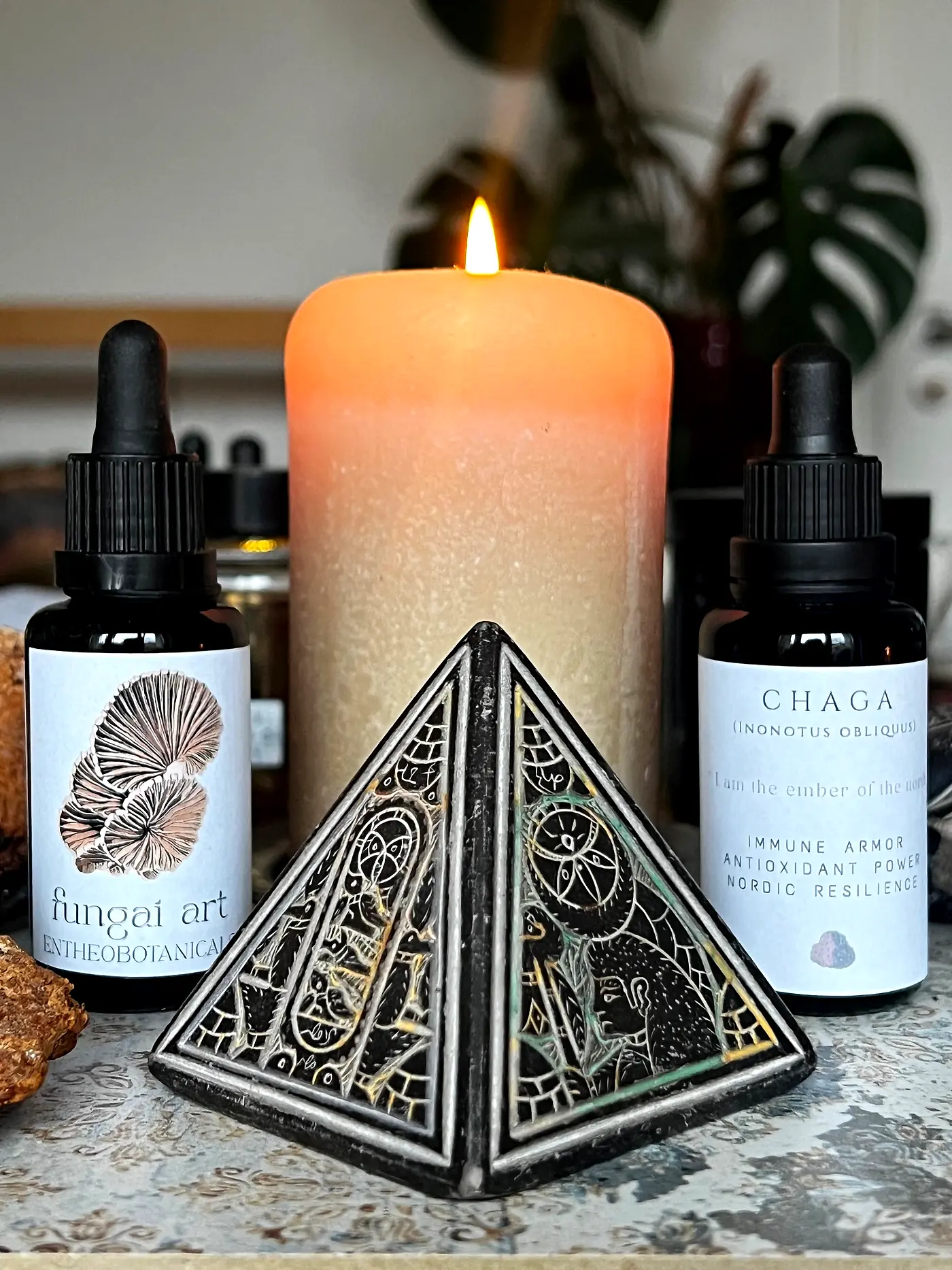
Chaga extract Foraged · Sweden Spagyric
Fungi · Nordic · Elder Alchemist

Chaga Extract

Inonotus obliquus · the birch's dark heart

The silent alchemist of the boreal forest. Drawing life from a wounded birch across decades, chaga transmutes decay into nourishment — a living metaphor for regeneration. Wild-foraged from Swedish birch stands, double-extracted (alcohol + hot water) so the fat-soluble triterpenes and the water-soluble beta-glucans both come through.

30ml€44
PreparationSpagyric double extract
SourceSelf-foraged, Sweden
Dose1–2 pipettes daily
The Story

Chaga is the elder who reminds us that decay is a form of devotion. It grows only on birch that has been wounded — a spore drifts into a scar and, over ten to twenty years, quietly transmutes the tree's wound into a hard, coal-black conk shot through with amber and gold. The Sámi and northern Slavic peoples have brewed it as tea for centuries; the Russians formalised it in cold-war-era pharmacological research as Befungin.

The interesting move happens at the molecular level. Betulin and betulinic acid — concentrated in the outer bark of the birch — concentrate in the chaga body. The beta-glucan polysaccharides and the dark melanin pigments are what researchers study in it — so far in the laboratory and in animals; no human trial has tested chaga yet.

"Thriving in decay, weaving new foundations — shadow, resilience, slow transformation."

Chaga is not a quick fix. It's a long relationship: a daily cup or a few drops through the dark months, the way northern households have taken it for generations.

What she carries
Betulinic acid · Betulin

The resinous compounds chaga draws from its birch host. They dissolve in alcohol, not in water — which is why we extract in both.

Beta-glucan polysaccharides

Studied for their action on innate immune cells (NK cells, macrophages) in laboratory and animal work. The water-soluble half. This is why real chaga preparations must be double-extracted; alcohol-only extracts miss the polysaccharides entirely.

Melanin

The dark pigment of the conk, an antioxidant in laboratory studies — and the reason chaga tea is so dark and inky.

SOD · Superoxide Dismutase

Superoxide dismutase — an enzyme the birch conk carries, and one of the reasons chaga is so studied.

How to take it

1–2 pipettes (about 13–26 drops) sublingually (under the tongue), once daily. Best in the morning — chaga has no stimulant note but a gentle warming quality that pairs with the start of the day.

Take it in courses: up to 8 weeks of daily use, then a week or two off. Chaga is high in oxalate, so it is not for long unbroken daily use.

Also used as the umami spine of the forest broth in the Dinner Experience.

Safety notes
  • Anticoagulants (warfarin, DOACs): chaga has mild antiplatelet activity. Monitor if you're on blood-thinning medication.
  • Autoimmune conditions: chaga is immune-modulating. Discuss with your clinician if you have RA, MS, lupus or similar.
  • Kidney stones or kidney disease: chaga is very high in oxalate, and long daily use has caused kidney damage in published case reports. Not for anyone with kidney stones or kidney disease; with long use, take breaks.
  • Pregnancy and breastfeeding: limited data. Traditional use supports safety but formal studies are absent. Discuss with your practitioner.
  • Compatible with: most pharmaceuticals, most other tonic herbs, most protocols. This is a foundationally safe herb with a long track record.